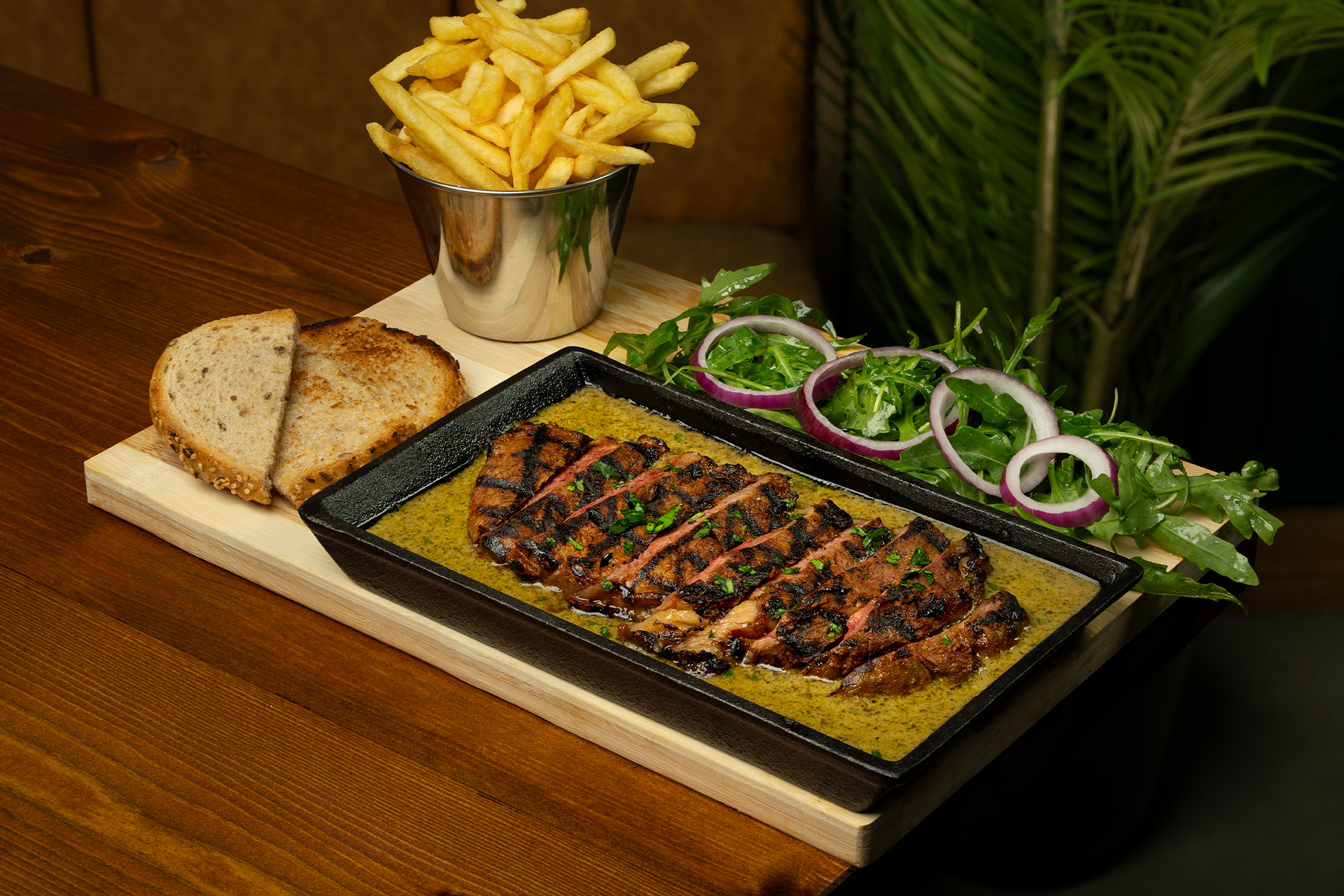
The Geneva story behind Café de Paris sauce, why it works so well with steak, and how we make ours.
If you have ever eaten at one of those steak restaurants where the menu has precisely one main course on it, you'll know the sauce we're talking about. It arrives pale green, glossy and still bubbling slightly, poured over sliced steak, and within about four seconds of the first mouthful you understand why the place doesn't bother offering anything else.
Most people in this country have no name for it. Some call it green butter, some call it entrecôte sauce, and plenty of people who have eaten it in Dubai or Beirut simply call it Swiss butter. They're all describing the same thing, and it has a proper history behind it.
It isn't French, it's Swiss
Despite the name it usually goes by, Café de Paris sauce was not invented in Paris. It was created in Geneva, at a restaurant on the rue du Mont-Blanc called the Café de Paris, and it has been that restaurant's speciality since the 1930s.
The story goes that the recipe came from a man named Boubier, whose daughter married Freddy Dumont, the owner of the Café de Paris. Dumont put it on the menu, the restaurant became famous for it, and the family kept the recipe to themselves. Nearly a century later they still have. There is no published original, only a long line of chefs and food writers who have tried to work out what's in it.
The restaurant built its whole business on that one dish. Entrecôte, cooked how you like it, with fries, a green salad and the sauce, served on a hot platter kept warm over a candle. That was the menu.
How it conquered the world
The idea travelled before the recipe did. A Parisian restaurateur copied the single-dish model and opened his own steak-frites house in Paris, serving a closely related butter sauce of his own, and the format turned out to be unstoppable. Those restaurants multiplied into London, Barcelona, New York, Beirut, Doha, Riyadh and Dubai, and every one of them has people queueing outside with no menu to look at.
That's how the sauce reached the Gulf, and it's where most British people have actually tasted it. Ask someone who has spent any time in Dubai what they miss most about eating there, and a surprising number of them will describe a green butter sauce before they describe anything else.
So what's actually in it?
Nobody outside Geneva knows for certain, and that's part of the appeal. What everyone agrees on is the structure of it.
The base is butter, softened rather than melted, worked through with a long list of herbs and aromatics. Thyme, tarragon, chives and parsley do most of the green. Shallot, garlic and mustard give it bite. Then there's a savoury backbone underneath everything else, built from things you would never guess by tasting it, which is where most versions quietly use anchovy, capers and a little curry powder or paprika.
That's the bit people miss when they try to recreate it at home. Garlic butter tastes of garlic and butter. This tastes of about twenty things at once, none of which you can name individually, and the savoury depth running under the herbs is what stops it being sickly after three mouthfuls.
It also comes in two forms. The classic version is a compound butter, rolled into a log, chilled and sliced so it melts over the steak at the table. The restaurant version is looser and creamier, closer to a sauce, and that's the one served over the sliced steak in a pool on the plate.
Why it works so well with steak
A chargrilled steak is dry heat from start to finish. It gives you crust, smoke and char, which is exactly what you want, but it gives you nothing to carry those flavours across the plate.
Butter does that job better than any cream or stock-based sauce, because it melts into the meat rather than sitting on top of it and the fat picks up the juices as the steak rests. The herbs cut through the richness, the mustard and the acidity keep it lively, and because it's served hot against a hot steak it stays loose enough to coat every slice.
Then there are the fries, which is really the whole point. A sauce this good turns a side order into the reason you clear the plate.
How we make ours
We make our entrecôte sauce here, from scratch, every day. It took us a long time to settle on the blend, because the easy version of this is to throw herbs into butter and call it done, and the easy version is never the one people drive across a city for.
Ours is built on the same principles as the original. Real butter, fresh herbs chopped the same morning, aromatics cooked down rather than added raw, and a savoury base underneath that we're not going to write down on a website. It's made in small batches so it's never sat around, and it goes onto the steak hot so it melts straight into the meat.
And unlike almost everywhere else, it isn't a five pound extra. It comes with the steak, because a chargrilled entrecôte without it is only half the dish.
How to eat it properly
There's a right way to do this, and the people who have eaten it in Geneva or Dubai will already know it.
Start with the steak on its own, one slice, no sauce, so you taste what the grill has done to it. Then go in properly. Drag each slice through the sauce rather than spooning it over, keep the fries close, and when you reach the end of the steak, use the fries to finish what's left in the bottom of the plate. That last part is not optional.
If you want to do it the way the Genevans do, eat slowly enough that the sauce is still warm when you get to the end. It's a butter emulsion, and it's at its best hot.
Come and try it
Our steaks are £20, and that price includes the lot: a chargrilled Black Angus steak cooked how you ask for it, crispy fries, a house salad and our homemade herb entrecôte sauce. No sides to add on, no sauce surcharge, no small print.
The grill runs from 4pm daily. If it's your first time, have the entrecôte and let the sauce do what it's been doing in Geneva since the 1930s.
Strami & Steak — 1 Shaw's Passage, Digbeth, Birmingham. Good food. Properly made.
All News